
Flotsam is also the stuff of salvation
Dr. Kenda Creasy Dean of Princeton Theological Seminary’s Institute for Youth Ministry, is one of the most widely read scholars of practical theology, youth ministry, and church leadership. She is an icon, an expert in her field by every possible measure. If there was anyone that the mainline church would follow to help them make sense of their peri/post-pandemic reality and guide them through these uncertain waters, it’s her.
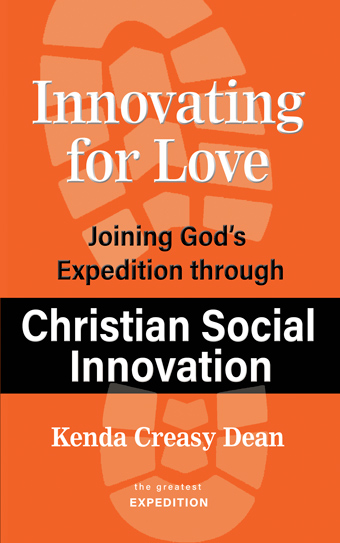
And in her new book, Innovating for Love: Joining God’s Expedition through Christian Social Innovation, she celebrates the liberating joy of having no idea what you’re doing.
Dean’s book is a theological and practical exploration of Christian social innovation (although she’s not crazy about the word innovation). It firmly draws its foundation in the call of Christians toward loving response to the needs of the neighbor and as far from twenty-first-century entrepreneurial “innovation” culture as possible.
She tells the story of the apostle Paul’s shipwreck on Malta. Paul was a prisoner on a ship, and he told the crew that the ship would be destroyed, but not to be worried because none of them would drown. The vessel broke up into hundreds of pieces, but all 276 people on board lived, floating to shore on the pieces of the boat’s wreckage, called ‘flotsam.’
Many of us doing ministry in a post-2020 world feel like we have experienced what can only be considered a shipwreck. In all our lives, but acutely in our church lives, there is a “before” and an after. The institutional framework of the church was already in the midst of a shift. Those paying attention have been aware of the gradual decline of the American vision of the church and were challenged to rethink its role in a new era where cultural Christendom was no longer the norm. Even where it still held on, the institution showed serious signs of rot. The pandemic took those cracks and busted the whole ship wide open.
But, in Dean’s words, like in Paul’s shipwreck,
“Flotsam is also the stuff of salvation.” She continues, “What people on Malta seem curious about isn’t our universal truth, but our individual stories about how God saved us and brought us to shore.” On the Island of Malta, they still celebrate the anniversary of the shipwreck as a miraculous intervention on their behalf.
Dean takes the challenge of approaching the shipwreck of our old ways of being church and not only sees a possible future but delights in the truth that we have a moment to build something completely new in the wreckage. This new thing is not based on some grand plan or vision but sorely on the calling of Christ to love whoever is in front of us. She highlights that “if one virtue stands out in this covid-shaped church, it is humility.”
Christ has turned the tables: in this place, holy curiosity matters more than excellence; being kind is more important than being right; discerning Jesus’ path is as necessary as declaring it.
This season of innovation in the church, built in “grottos and crevices rather than on hills and town squares,” encourages a playful liberation of the Church from being an institution of power and authority to one that can humbly engage with whatever openings the Holy Spirit may present.
Throughout her brilliant and accessible book, Dean walks through common pitfalls to avoid, simple concepts to keep in mind, and dozens of powerful examples of innovative ministries in insets spread throughout the book. Like all her work, Dean’s book is deeply anchored in rich theological exploration and practical applications. The book also has prompts for discussion and further thinking to help those reading it apply its wisdom to their context.
For anyone in the field of Christian social innovation (or its variety of sisters), this book is not only essential but freeing. The book encourages leaders to remember their roles as those that remove the barriers to God’s work of resurrection, not those responsible for resurrection itself and normalizes the unglamorous, often tedious, trial-and-error approach of stumbling your way into innovation done for the sake of love of neighbor.
For all of Ministry Incubators’ systems, plans, tools, and schedules, we are an organization that fundamentally believes that it is God who does the innovating, who brings life out of death. Dean’s book is an encouraging reminder of God’s faithfulness in God’s resurrection work and our call to continue to unbind one another and make way for that work to be done.
The book, Innovating for Love: Joining God’s Expedition through Christian Social Innovation is available via market square books and is available for 20% off for the next week with the code TGEKENDA.










0 Comments