
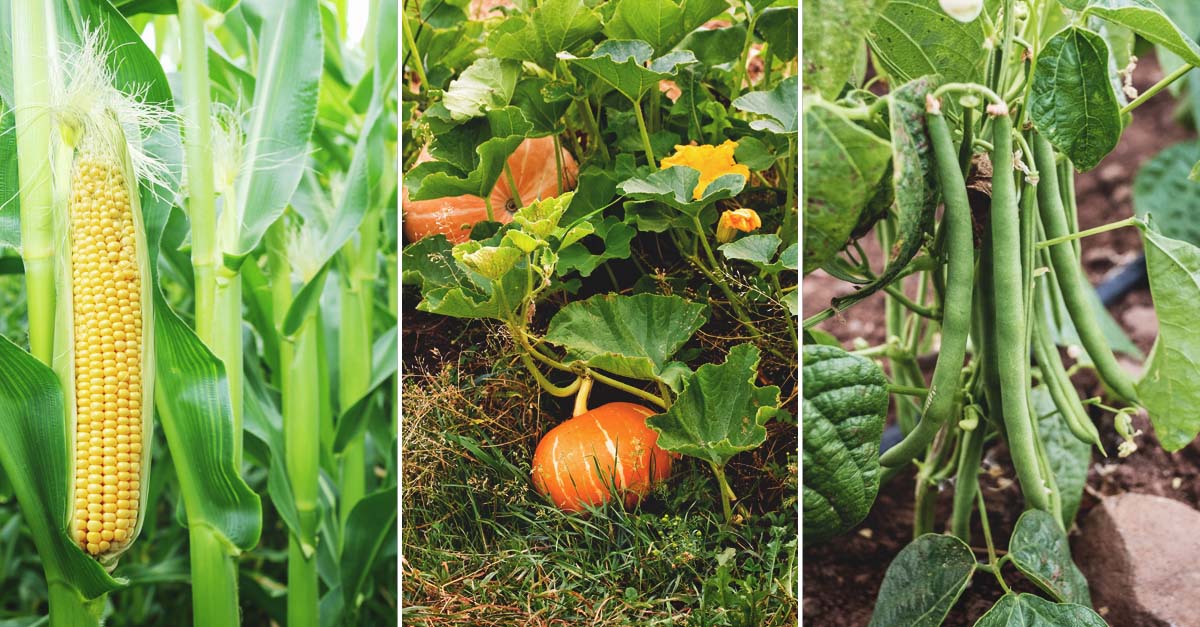
When the first Europeans landed on what is now called North America, they noticed an agricultural practice of the indigenous population that was radically unfamiliar to them. They saw gardens, where, instead of neat rows of separated crops, beans wrapped themselves around corn stalks, and pumpkins grew thick stems around their bases. They took these intermingled crops as a sign of lack of sophistication and sought to “educate” native communities on how farming should be done.
What the settlers didn’t understand was that the practice of growing not just any old crops together, but those three specifically, constituted what is known as a Three Sisters Garden. Because of the growth speed, root structure, and unique properties of each plant, growing corn, beans, and squash or pumpkin together makes all three grow more successfully.
Corn, the ‘eldest sister,’ grows first, providing a straight and strong stalk within a few weeks, so that when the ‘middle sister,’ beans, begins to crawl out of the ground, it already has a safe and steady path off the ground, and towards the sun. The beans’ unique capacity to turn nitrogen in the air into nitrates in the soil provides necessary nutrients for the corn, and for the ‘baby sister,’ squash. The squash grows last, and stays close to the ground, with broad leaves and thick vines covering the ground near the base of the corn, stopping weeds, animals, and insects from getting too close. ))
The three sisters together also constitute a rich meal, full of carbohydrates (corn), protein (beans), and vitamins (squash). To this day, communities that have maintained these practices have “Three Sisters Dinners” where they feast on the gifts that these ‘three sisters’ together offer.
When we stumble across something truly wonderful, we so often seek to break it into its component parts, to categorize, analyze, dissect, and contain it. We call it sophistication to break everything into its atomic units. We think it is the hotel we stayed in that made our vacation wonderful, the curriculum a church used that made their small groups successful, the timeslot or location that made a church plant work, and so we pick apart what we love in order to measure its component parts.
Native agricultural wisdom suggests that sometimes it is the sisters’ growing together that creates the magic. Sometimes the mechanics of what creates balanced, sustainable growth, are better observed as a cohesive phenomenon than pieced apart. We can frustrate ourselves and those we lead when we assume that we have dissected the appropriately magical component of an organization only to find that it doesn’t work for us the same way. In all likelihood, we underestimated the cumulative effect of the entire context on the success of those whom we seek to copy. When we find organizations, institutions, or programs that seem just to work, how can we learn to factor in the Three Sisters effect in our analysis?
Questions to Ask When Observing Healthy Systems:
- What unnamed resources have helped this system succeed?
- What symbiotic relationships with the community, culture, or context have developed?
- What organic solutions might be growing in my own context that I’m not seeing?








0 Comments